Pharmacy Residency Interview Tips for PGY-1 and PGY-2
Originally published January 15, 2023

I definitely found preparing (and stressing) for residency interviews the worst part about the process. I think because there is a lot of pressure to make sure you fit well with the program, they get a true sense of who you are, and all while you are trying to assess them and if you would enjoy being a resident there for a whole year!
So take a deep breath, and know that you will be okay. Practicing and preparing always helps me feel less stressed prior to an interview so below I am sharing ALL my interview tips and exactly how I prepared.
My credentials and past interview experience:
I applied and interviewed for PGY-1 and PGY-2, matching in Phase 1 for both.
My application stats:
PGY1: Applied to 15, offered interviews for 11, interviewed 10*, ranked 9, matched #2
*had to decline one interview due to being unable to schedule with available interview dates offered
also, full transparency that I panic applied to an extra program in January due to fear I wouldn’t get interviews (don’t know why I was thinking that!). not a proud moment, so I ended up interviewing with them but not a great fit at all so did not rank.
PGY2 (ambulatory care): applied to 12, interviewed 12, ranked 12, matched #1
Other interview experience:
Interviewed for many pharmacy technician roles prior to residency including outpatient pharmacy (2), hospital pharmacy (1), and a VALOR internship (Veteran Affairs summer internship). The internship is quite competitive and both the hospital and internship interviews had panel-style interviews very similar to residency interviews.
Since then, I have had a behind the scenes look at the interview process as a PGY-1, PGY-2, and now resident preceptor.
When to expect interview invites?
Typically start being sent out mid-January through February, the latest being mid-February for most. The most common time is around the 2nd to 4th week of January (remember they are reviewing a lot of applications on top of their full-time jobs, it takes time!)
There is a interview Google spreadsheet that circulates on the pharmacy residency subreddit every year. I did look at it while I was waiting for interviews but it honestly is not that helpful. Just because others got an interview and you are still waiting doesn’t tell you anything. Just be patient and wait!
Be sure to read the interview offer carefully for any requirements, expectations, or other pertinent information. Stay organized as best as possible. I made a word document with a table of all my programs I applied to, whether I had been offered an interview or not, and what day I scheduled an interview if I did. That way when you have more interview offers you can double-check them with your document so you don’t double-book yourself.
What are residency interviews like?
Most programs will send you an itinerary of the day.
Usually, it includes an introduction with the residency program team like RPD, preceptors, and/or residents. Then typically it leads to interview panels with different groups. Most commonly you will have an interview with the RPD, an interview with preceptor panels (can be 1-3 or more), and often some opportunity to speak with residents whether it is a formal interview panel, Q&A session (you ask questions but they are not interviewing you), or eating together for lunch.
For interviews longer than half a day, there is almost always some built in time for bathroom breaks, water breaks, etc.
Some interviews may require you to present something (journal club, topic, patient case, or a more general About Me, or a specific prompt) – see more about this in a below section about presentations
Example of one of my virtual PGY-1 interview schedules:
(names removed)
12:00 pm – 12:30 pm PGY2 Ambulatory Residency Program Director—, PharmD, BCPS, BCACP, CPP, Clinical Pharmacist, Health Center, PGY2 Residency Program Director—, PharmD, BCPS, CPP, Director of Pharmacy Education, Family Medicine Center and Residency Program, Associate Professor of Clinical Education, School of Pharmacy
12:30 pm – 1:00 pm Overview of PGY1 Training Program with RPD
1:00 pm – 1:30 pm Discussion with Current Residents
1:30 pm – 2:00 pm Group Discussion with Pharmacy Leadership Team
2:00 pm – 2:30 pm Preceptor Group 1
2:30 pm – 3:00 pm Preceptor Group 2
3:00 pm – 3:30 pm Clinical Administrators
General logistics
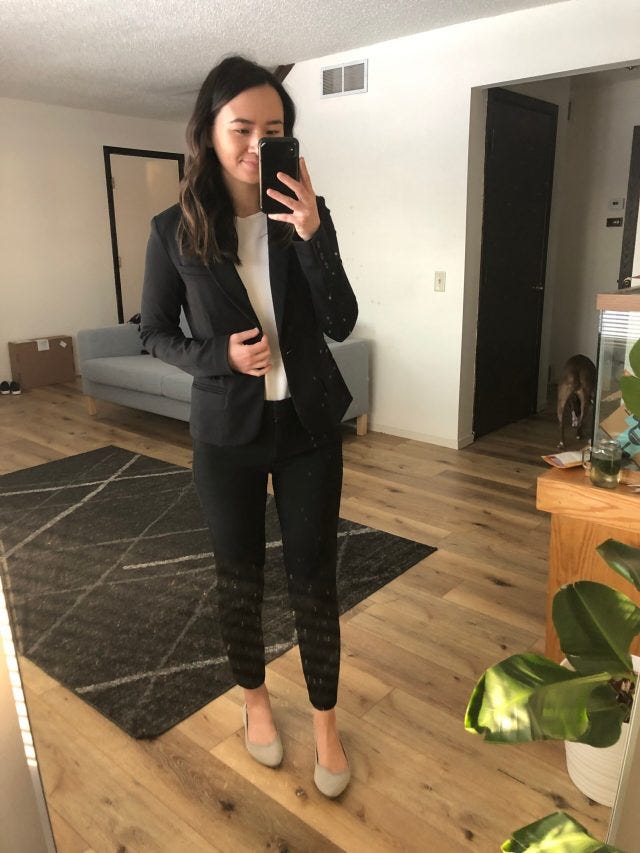
Dress code: business professional. This means suit jacket, tie or professional blouse, slacks/pants or business skirt, dress shoes. Avoid low cut shirts, short skirts, casual wear (no jeans, gym shoes, leggings, t shirts, etc).
Bring water and small snacks. Bring lunch if you are going to be in the interview for more than half the day (unless they tell you otherwise such as they are providing lunch, etc).
If in person, be sure to confirm things like parking, when to meet and who you are meeting with, and buffer enough time to be on time!
If virtual, consider where you will interview. Ideally a quiet place without interruption, a professional or plain background (avoid messy bedrooms!), and a good Wifi connection. Have a backup plan if possible. Consider a ring light in case your interview day is really gloomy! I also like using a stand for my laptop so the camera is at eye level (still using the same laptop stand whenever I work at home at my desk as a resident!). Ensure your devices are charged. Check you have all the necessary links to virtual platforms you need once an interview is scheduled.
What to prepare for?
Answering interview questions
Questions you want to ask the program
Clinical questions
Presentations, if required by the program (they will tell you in advance)
Below, I break down all of these into detail.
Common Resident Interview Questions:
Tell me about yourself
This is your elevator speech. Definitely be ready to answer this MANY times. The recommended structure should be: “My name is __, I am a fourth year pharmacy student (or other if you have a different current role) at Pharmacy School Name. I am from City, State. Then list 2-3 major important points on why you are interested in residency and if able customize to the program you are speaking with.
Here is an example of mine: My name is Shelby Lastname. I’m from City, State and went to the University of — for undergrad before staying on for pharmacy school. I completed an internship with the — Hospital and was very involved with Phi Lambda Sigma and APhA during school. I am looking for a residency program with a variety of ambulatory care and acute care rotations to ensure I am a well-rounded practitioner, which will help me pursue my goal of PGY2 ambulatory care and practice in a clinic setting.
You can make it more or less specific depending on who is asking and in what context. To be honest, sometimes I would have interviewers ask me this, and then just smile and move on to the first question. So it sometimes can feel a bit awkward and I would shorten it so I was only talking for a max of 2 minutes.
Strengths and weaknesses
Residency-specific questions (why are you interested in our program, etc)
Behavioral style questions (tell me about a time…)
Clinical questions to assess your thought process and critical thinking skills
CV: be prepared to answer questions about your experiences on your CV. Be able to explain your work history, rotations, presentation topics, research, leadership, etc. Everything on there is fair game!
List of interview questions:
There are many great resources out there for example interview questions.
I used all of these to get ideas for questions I might be asked:
100 Strong Residency Questions, Answers, and Rationales – although this one is not free, I found it extremely helpful since it also discussed how to answer the questions
How to prepare for interview questions:
First, I created a word document to brainstorm and organize information:
“Tell me about yourself” elevator pitch
List your experiences thus far
Examples: volunteering, leadership roles, internships, work experience, and research.
Then list below those unique experiences you can speak to (I didn’t write full sentences, just brief bullets to remember that experience or event)
List your APPE rotations completed so far
List in bullets under each one
any projects including detailed accomplishments with the project (# of patients impacted, presentation to which groups, etc)
clinical accomplishments (# of patients rounded on or seen in clinic per day)
any unique patient stories/rotation experiences (difficult feedback, develop rapport with provider, made a mistake, etc)
interventions made
interaction with other healthcare professionals
I also create a separate section to organize experiences/accomplishments into different “themes”, some with subcategories, which will help you brainstorm ideas to answer behavioral style questions. There likely will be overlap with the above information, but I found it help to reorganize it in this way.
Teamwork
Problem-solving
Failures
Conflicts
Innovation/creativity
Leadership/Initiative
Interpersonal skills
Interdisciplinary team
Residents
Peers
Challenge/stress/pressure
Public speaking
Adaptability
Overwhelm/time management
Other
Medication error
Teaching
Research
Cultural awareness
Self-reflection
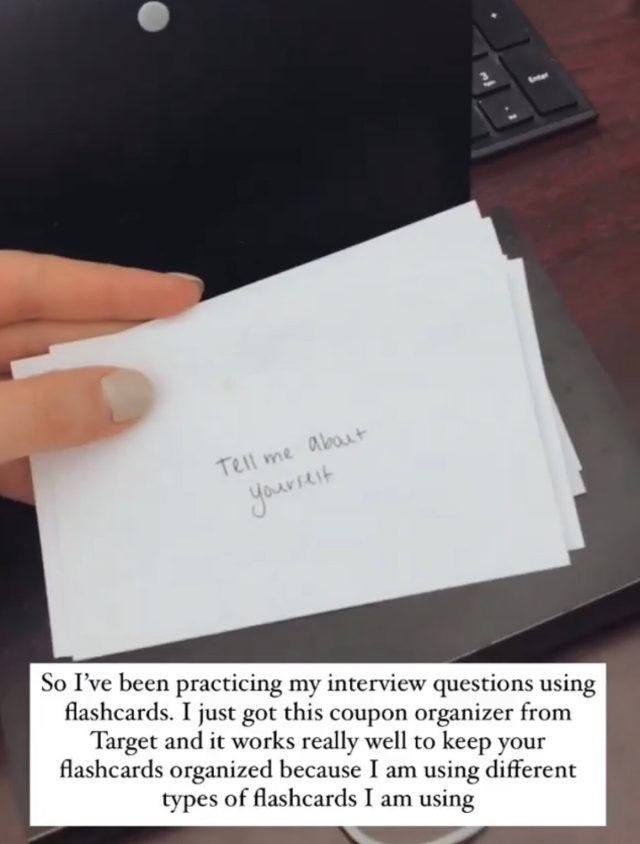
Next, make flashcards:
I found this step crucial to organizing my responses to common questions and allowing me to practice them regularly. I used a coupon organizer to store them which worked super well because I could label each section with the type of flashcards they were.
First, I found lists of common residency questions in all of the categories I listed above (intro/general, residency specific, behavioral, and clinical). I used flashcards and wrote topic/themes to the questions. On the back, I wrote positive (or just “+”) on the left and negative (or just “-“) on the right. Below each, I wrote brief bullets on different scenarios to answer that question.
An example:
front side: teaching
back side:
positive
case presentation to students on rotation
patient clinical competition presentation and practice session for participants
student ambassador
therapy lab teaching assistant
negative
unprepared student in therapy lab
exam question feedback from students
Note: below I list all my flashcards. I didn’t write an answer for all of them, mainly for the general topics. For the unique questions, I used them as a way to practice my answer but didn’t write it on the actual card just for sake of time.
How to answer interview questions:
I wholeheartedly recommend the STAR method for interview questions. I’ve used this for ALL my interviews since interviewing for my internship!
STAR stands for:
Situation: describe the situation you were in or the task you wanted to accomplish. be specific to the interviewer understands.
Task: your goal
Action: describe the action you took to address the situation with detail. focus on YOU.
what specific steps did YOU take
what was YOUR contribution
use “I” and not “we” for team/group tasks and describe your actions
Result: the outcome. be sure to highlight the positives and reflect upon what you took away from the experience. if appropriate, I also like to tie it into residency and their program.
what happened?
how did it end?
what did you accomplish?
what did you learn?
Example STAR response:
Question: Tell me about a time when you failed
Answer:
Situation: During my 2nd year of pharmacy school, I had become very involved with Phi Lambda Sigma Pharmacy Leadership Society. By the end of that year, elections were coming up for multiple roles.
Task: I decided to run for president after support and encouragement from older members.
Action: The election involved presenting a 2 minute speech to all the members. Another member and I both ran for President. I prepared my speech, rehearsed it over and over.
Result: I presented the speech and felt it went very well. Members voted, and I lost. I had the option to then run for Vice President right after. I hadn’t prepared a speech for that, but spoke from the heart about my passion for the organization. I lost. Finally, the position for secretary was next. I gave a third speech, and this time won. Afterwards, I recieved so many congratulations and support from my peers. However, I felt defeated because to me I had failed. That night, I decided I wasn’t going to let “not having the title” prevent me from giving my all to the organization I cared so much about. That year, I co-chaired a community event that won a national award, co-planned a school wide leadership event, and presented a national presentation about our event at APhA Annual. All of these tasks were not requirements of the Secretary. Although that night I felt like failure at first, I realized it’s not always about winning. It’s about what your reaction to failure, how you show up for others, and what kind of impact you can leave when you are done. I know I will likely have setbacks and challenges during residency and plan to use those as a way to learn and grow, rather than feel like I failed.
This is a true example I used during interviews and it highlights what I learned from that situation, how I can apply it to residency, and also bonus point highlights a leadership role from my CV and provides more context to it!
Try not to ramble as it can get lengthy, keep at ideally 2-3 min max (beyond this I feel people have a hard time staying full engaged in your answer).
Negative “style” questions:
you may get questions that initially are negative. for example, tell me about a time when you made a mistake, when you failed (like the example above), when you experienced conflict, etc
I still recommend using STAR to answer these
one extra tip I have is to always end on a positive note. what did you learn from the experience and what will you do differently in the future.
Abbreviated Example: time when you received constructive or negative feedback from a preceptor
Bad example: I was told my clinical knowledge for my acute care rotation is weak, but I don’t plan to go into acute care after residency. they did give me positive feedback on my leadership and communication skills.
Good example: I was told my clinical knowledge for my acute care rotation is weak during my midpoint evaluation. I initially felt really sad about this because I hadn’t received bad feedback up until then and I was not used it. However, I really appreciated the opportunity to know what to work on. I discussed further with my preceptor to identify specific clinical areas to work on, sought out patients on rotation to get more clinical experience with, and also studied on my own to create study notes on common clinical disease states and concepts to increase my knowledge. By the end of the rotation, my preceptor pointed out how much I had improved my knowledge and confidence with acute care clinical areas. Although I still have more to learn and I look forward to continuing to improve my clinical skills during residency rotations.
Other tips:
You may have interviews where you are asked the same question by two different preceptor panels. I honestly found this off-putting because I didn’t know if they wanted me to answer the same or different than the prior panel. There isn’t a “right” way to answer, you can use a different response or the same one. If you have another good response that is different, consider going with that one for better variety. But it’s not wrong to re-use your answer with a different group!
Remember that programs are trying to find out who you are as a person, will you fit in with their program, and does the program match up well with your goals. Keeping this in mind when answering questions was helpful for me.
What questions YOU should ask during interviews:
How to decide what questions to ask:
I made a Word document for each interview and included a list of questions for each “group” I knew I was going to interview with. I tried to focus on asking questions that helped me determine how I would want to rank the program based on what I was looking for.
workplace culture as I knew I wanted to be somewhere that really cared about their residents and valued them as part of the pharmacy team
residents had with their RPD and how well supported residents felt
anything I couldn’t find out from online like how electives were chosen, staffing model, teaching opportunities, etc
I kept all my info about programs in the same excel spreadsheet I used when finding programs to apply to. This helped me determine what I didn’t know and what could be good things to ask about.
General tips:
there is no minimum required amount you should ask but I usually had 5-10 I could ask each group. be prepared that some of the questions may be answered during the intro session or other parts of the interview, so having more is best to avoid any awkward silence.
it’s okay to ask the same questions to different groups of people. I actually found this really helpful to see if they had similar answers about culture, pharmacists role in their institution, etc. Everyone has different experiences so can be helpful to hear more answers.
asking questions helps show your interest and you don’t want to end early because you “have nothing left to ask”. there are always things you can ask about. don’t be afraid to have small talk or ask people about the geographic area and get to know them. you never know what you might find out and it helps to show your personality more
it’s okay to take notes when you ask a question and they answer. just would advise you to write on paper and not on the computer for virtual interviews, because typing is distracting
be mindful of the time. I usually would say something like “I see we are at the end of the scheduled time so I want to be respectful of your time. Thank you for answering all my questions, it was really helpful. I appreciate your time spent interviewing me and it was great to get to know you better.” Usually they will say if you have additional questions to email them and you definitely can if you have more you needed answered
remember that as much as they are interviewing you, YOU are interviewing THEM! ask questions to help you know the program better, the people better, and gather information that will make your ranking decisions easier when the time comes.
Clinical interview questions
This is definitely the part of the interview I felt most nervous about, as do most residency candidates.
Clinical question tips:
know they aren’t expecting you to be an expert, that’s the whole reason why you are pursuing residency right? they are looking to see how you critical think, act under pressure, and how you present information
if you don’t know the answer, that is okay! but be prepared to answer in those situations. typically it is good to say you don’t know but you would check x, y, z resources to find the answer. if you offer to check and follow up with them, be sure to actually follow through (but in most cases I tried to avoid offering this because it just wasn’t necessary)
questions can be asked in various ways
“typical” clinical question – such as a patient with x, y, z symptoms diagnosed with CAP and has a penicillin allergy. what do you treat them with? they may also add in follow-up questions such as what do you discharge them on, what is your duration of therapy, etc.
priority management – such as 1 patient requiring discharge counseling, a call from a nurse who can’t locate a IV antibiotic medication, and an order for acetaminophen to verify in the computer, in what order do you approach these tasks and why?
patient counseling scenarios – teach how to use an inhaler, or injectable device, counseling someone starting warfarin or DOAC, etc
patient cases or fake patient visits including opportunity to gather information, ask the “patient” questions, formulate A/P and may ask you to write it out or present it verbally
there may be other variations of ways to ask clinical questions too (but don’t let this scare you, it usually is not meant to confuse you! and hopefully should be things you have at least seen during APPE rotations)
ambulatory care heavy residences may focus more on outpatient type questions while acute care heavy residencies may focus more on inpatient type questions, but be prepared for both
You may or may not get access to resources. For most of mine, I did not!
How I studied for clinical questions:
I personally study best by writing out a “study guide” to myself, so I approached this similarly. I started this in early January and continued through interview season mid-late February, adding things that came up from interviews if I wanted to review.
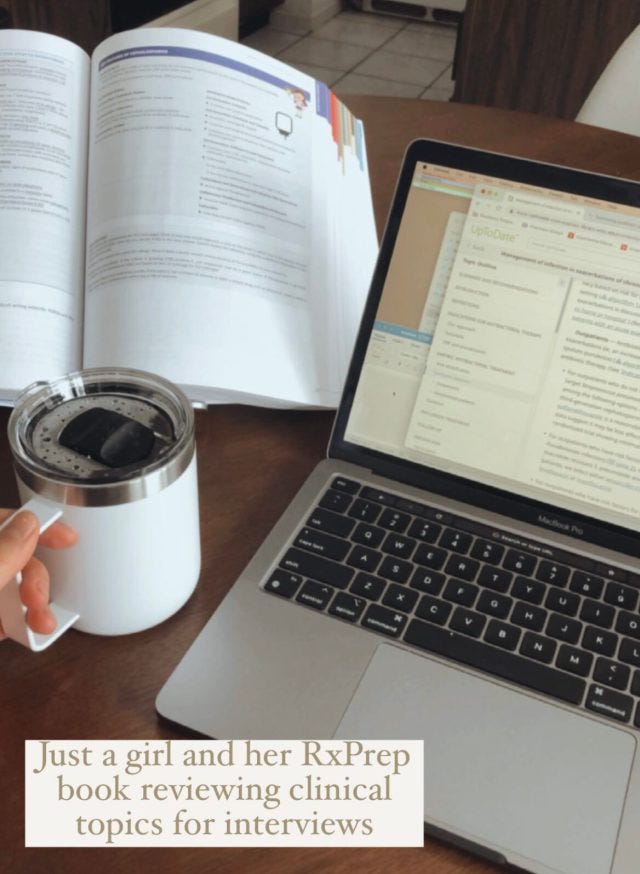
I used the NAPLEX RxPrep book to review concepts. I highly recommend you split your book and get it spiral bound so it’s easier to study from and carry around if needed! (I talk about how I studied for the NAPLEX in-depth here).
PGY-2 specific advice
my patient cases were way more advanced for PGY-2 interviews, which makes sense. for PGY-2 Ambulatory Care interviews, they were fully detailed patient cases, like you might get in clinic and I was expected to ask questions and formulate a full A/P for all pertinent problems. commonly patients had multiple disease state problems. common disease states – HTN, HLD, DM, COPD, asthma, depression/anxiety/PTSD, BPH, Afib, CAD, HF.
Almost all my interviews had these style clinical questions in the form of patient cases, which was different compared to my PGY-1s which seemed less formal style questioning
I didn’t actually prepare that much for clinical questions for PGY-2 interviews because I truthfully was too busy with PGY-1 responsibilities. I do think it would be good to really know the “bread and butter” of your specialty and expect to be asked clinical questions about it.
Interview presentations
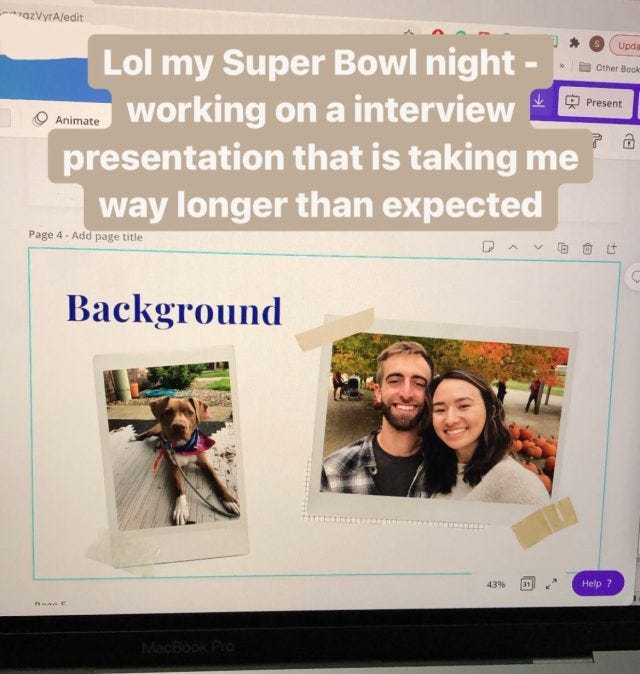
Sometimes you may have a requirement to give a presentation. It may be a journal club, case presentation, topic presentation, or about me presentation. Presentations are much more common for PGY-2 interviews and less common for PGY-1 interviews in my experience.
Topic selection
recommend picking a topic or journal that is not super popular, as it will likely be overdone. common topics are easy to pick apart as well, so consider you will need to be very well prepared for questions as the preceptors will likely have many for a easy/well known. for example, when I was interviewing SGLT-2s for HF had recently been published in journals and everyone was talking about it. I avoided picking that as a topic because people may be sick of hearing about it and also may ask me really nuanced questions I didn’t look into
be original and engage the audience! try to make your presentation easy to remember, follow, and interesting.
even better if you can reuse a topic you have already presented on during APPEs (or PGY-1 if you are applying to PGY-2s, etc)
What to include:
Case presentation: introduce the case, brief disease state review, guidelines, and relevant literature to answer the clinical question, what happened to the patient and does it match up with the guidelines, what you would do differently, future considerations/recommendations.
Journal club: should be pretty similar to the standard journal club format used during APPEs but may need to convert it to PowerPoint if that is the requested presentation format for the interview instead of a handout
About me: if they don’t give you guidelines on what to include, some ideas include background, education, family, hobbies, travel, future life goals, special skills, etc.
Specific about me topics I used (the program required something more specific): How to visit Bejing China (prompt was to teach them something), Weightlifting (prompt was to discuss a hobby or interest; I reviewed how I got into weight lifting, benefits of it, and tips for beginners).
Tips
be sure to stay on time and do not go over the time limit (practicing in advance can help with this)
include proper citations (AMA style) on slides and references slide at the end
example for on the slide: Nassif ME, et al. Nat Med. 2021;27(11):1954-1960
full AMA citation on references slide at end
end your slideshow with a copy of your first title slide, this is where you land at the end and ask the audience for any questions
avoid filler words like “so”, “but”, “um”
keep a good pace, avoid talking too quickly
make eye contact (if virtual, make an effort to look at the camera to simulate eye contact)
include audience questions if you feel appropriate based on time limit, can help with engagement
don’t just read off your slides
include images on your slides to keep them engaged. for one of my about me presentations, it was almost entirely out of pictures and only a few slides with words. I even included a “pop-quiz” for fun related to something I was interested in. for more professional presentations, questions using brief patient cases is useful.
be prepared to answer audience questions. if you don’t know an answer, you can be honest and say you are not sure what the answer is but can get back to them after the interview. avoid guessing or stating something incorrectly.
if creating multiple presentations, try to re-use the first one you create to save yourself some time!
Specific tips for PGY-2:
I did not have case presentations for PGY-1, but very common for my PGY-2 interviews (although not all of them required it).
I HIGHLY recommend you discuss with a mentor your topic selection, share your rough draft, and do a practice presentation with feedback. this is something my PGY-1 program offered but if they don’t, reach out to mentors to ask! I think the quality of my presentation was much better after taking the time to do those steps (rather than just doing it all on my own without feedback).
Topic selection: should be pertinent to your specialty but not common. ideally a grey area of medicine with relevant literature and/or recent guideline changes. it doesn’t have to be in an area the audience will be experts in. for example, I did a topic presentation on ATTR heart failure (a less common heart failure disease), so I presented on that topic for my interviews since I already knew it well and had existing material. my audience didn’t know it at all but I received great feedback. I also preferred only having 1 topic for multiple interviews so I didn’t have to practice multiple different topic presentations, just one with different time limits.
Self-reflection
This is one of the MOST important steps in the interview process.
There is a lot of adrenaline in this process, you likely are interviewing with multiple programs, and it is SO easy for them all to blur together.
Please take the time to self-reflect on your interview.
After my PGY-1 interviews, I made a voice recording on my iPhone with my immediate thoughts and feelings post-interview. After my PGY-2 interviews, I did the same but with a video of myself instead. I also started using a “template” so I would answer the same questions each time to compare to the other interviews.
overall, how do you feel it went?
questions you wish you would have answered differently or caught you off guard?
impression of the clinical experiences – required and elective rotations
teaching experiences (this was important to me)
staffing
research
RPD vibe
mentorship/preceptors impression
wellness/PTO/time off, did the residents seem happy
red flags, cons
post-residency where do people go
final thoughts
Another option instead of a voice message or video is to call the same person after each interview for a debrief. They can give you an outside opinion on which they think you liked best which is unique compared to just self-reflecting. Of course, ultimately the decision should be yours but it can be helpful to get outside input.
I also included an “as I go” rank list. Essentially my first interview would be #1. Then after my second interview, I would pick if that would replace #1 or be #2. And so on. This way I’m thinking about my rank list as I go, instead of just waiting until the end and being overwhelmed with which programs I should rank in what order.
Thank you emails
Thank you emails are definitely something that is expected and you should plan to send one for each program after your interview.
Thank you email vs via mail?
In the time of virtual interviews, it is becoming more and more accepted to send thank yous via email. If anything, it often is preferred as mailed cards can get lost in the mail or not reach the recipients until after ranking deadlines. I sent all mine via email.
Do not expect them to respond unless you ask a question warranting their response
Who to send thank yous to?
I hear varying advice on this. Ultimately, I think you should always send a thank you to the RPD. You typically spend 1:1 time with them during the interview and you know they spend a lot of time in reviewing candidates for their program.
Other people you may send thank yous to:
preceptors from interview panels
residents from interview panel or Q&A sessions
pharmacy leadership/administration from interview panels, etc.
If you sent an email to everyone you spoke with, that would be SO many emails. So personally, I always emailed the RPD, but then only emailed others if I had a memorable conversation with them and for those the discussion was usually 1:1.
How soon should you send thank yous?
Ideally by the next business day (if Friday send on Monday), at a minimum within 1 week. If its past this, I would still send it still, but try to be timely as possible.
FAQ:
How did you balance studying for the NAPLEX and residency interviews?
I didn’t! To be more clear, I didn’t study for the NAPLEX until after graduation. If you do want to start studying earlier, I think it is safe to wait until after interviews are done. If you stress yourself out too much, your interviews will suffer. More about how I studied for the NAPLEX here.
How did you get time off from APPEs for interviews?
Pharmacy schools definitely vary on this. If you can be on an “off” block rotation, that is ideal, but I did not do that. My school allotted 7 “professional” days for interviews that did not need to be made up. But I had more than 7 interviews. I discussed with my preceptors early and made plans on how to make up the time.
My January rotation was Admin which involved a lot of projects so my preceptor was okay with me making up the time via projects and I didn’t have to come in on the weekend or anything (they weren’t there anyways).
My February rotation was outpatient community pharmacy. I had to make up 8 hours on a Saturday due to missing a day for an interview.
This can vary a lot depending on what type of rotation you are on and who is your preceptor. The best thing is to be upfront right away when you know that you have interviews so you can plan in advance and meet rotation expectations.
How do you manage the stress of APPE rotation responsibilities and interview prep?
It is hard. What worked well for me was to separate the two. So I spent a day or evening on APPE deliverables (presentations, projects, etc) and other days or evenings I focused on interview prep. Most of the time I could work on APPE stuff during rotation hours and residency prep in the evenings and weekends.
It also helps to be honest with preceptors. They knew I was applying and had interviews. I communicated with them on where I was with projects and adjusting deadlines if needed for projects that were flexible (a great skill for residency too!)
Take the time to destress after interviews and try to take time to not work on APPEs or interviews as well. It is a very stressful period of time. I definitely felt burnt out by the end because I didn’t take enough time for my own well being.
Resources:
Interview questions
100 Strong Residency Questions, Answers, and Rationales – I found this extremely helpful since it also discussed how to answer the questions
General resources
Podcasts – yes I am a nerd and spent time interview prepping while driving to and from APPE rotations lol
The Luxe Pharmacist Podcast – yours truly is a guest on episode Flip the Script from Jan 2022, the others in the residency series are so good and I found them really helpful when I was a student!
There are a lot more out there if you search on Youtube or Spotify but I haven’t listened to them myself.
Final thoughts
Remember to have an open mind. You may go in with your top programs in mind and completely change which are your top programs by the time interviews are done and you know the programs better, which is totally normal!
You are always being interviewed, even when you are not in a “formal” interview panel. So with residents, with other staff not involved in the interviews, anyone you encounter on interview day. Be respectful and professional always! Don’t talk down about others or other programs.
Take a breath – this is such a stressful time but know that everything will work out even if you can’t see it yet!
Resources for paid subscribers
list of my flashcard topics
questions to ask during your interview
a list of disease states to study for clinical questions
templates for thank you messages to different panels from the interview
